Introduction to Heat Treatment Processes for Undercarriage Parts
Dec 29, 2025When sourcing undercarriage components like track rollers, carrier rollers, sprockets, idlers, and bulldozer track links, you have likely heard sales representatives emphasize that their products are "heat-treated" for superior hardness and wear resistance.
You may have encountered technical terms such as Annealing, Normalizing, Quenching, Tempering, Medium Frequency, High Frequency, and Quenching & Tempering (Q+T). These are all vital heat treatment processes, but how much do you actually know about their impact on the performance of your equipment?
Annealing, Normalizing, Quenching, and Tempering are commonly referred to as the "Four Fires" in metallurgy. By precisely controlling the heating temperature, holding time, and cooling rate, these processes alter the internal structure of the metal to achieve specific mechanical properties.
Annealing involves heating the steel to a specific temperature, holding it there, and then cooling it extremely slowly within the furnace.
The Goal: Its primary purpose is to "soften" the metal. It eliminates internal stresses from casting or forging, reduces hardness, and makes the steel easier to machine in subsequent stages.
In normalizing, the steel is heated and then removed from the furnace to cool naturally in the air. The cooling rate is slightly faster than annealing.
The Goal: It refines the internal grains and ensures a more uniform structure.
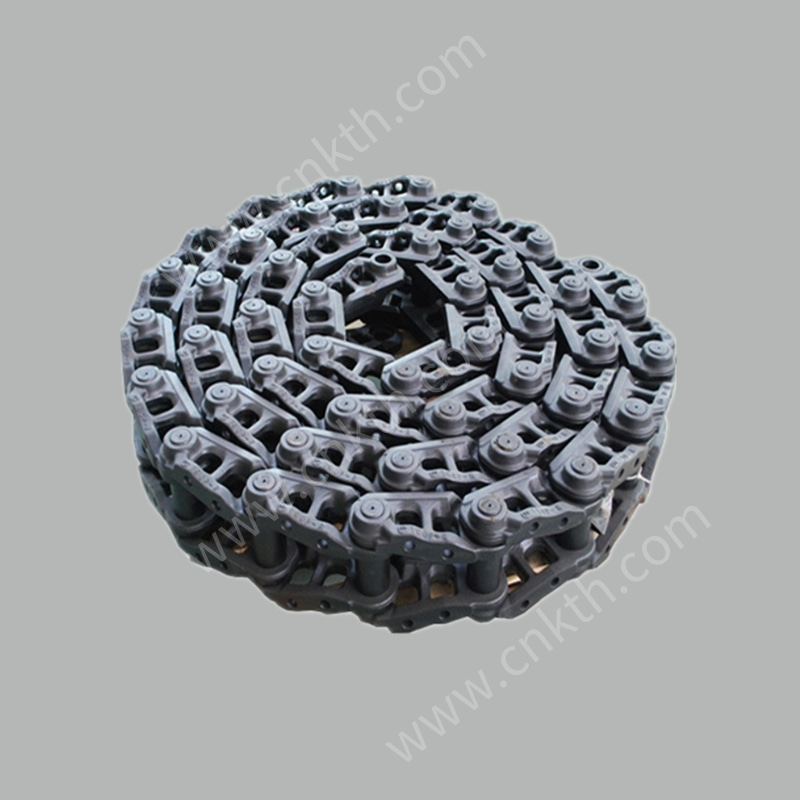
Application: In the production of bulldozer track links, 35MnB steel typically undergoes normalizing after forging to eliminate forging defects and lay a solid foundation for the final quenching.
Quenching involves heating the steel to an austenitizing temperature and then immediately immersing it in water or oil for rapid cooling.
The Goal: To significantly increase the hardness and strength of the metal. In bulldozer track links manufacturing, this is the critical step that gives 35MnB track links their high-hardness surface.
The Downside: Quenched metal is like glass—hard but extremely brittle. Without further treatment, the internal stress is so high it may crack on its own. Therefore, quenching is almost always followed by tempering.
Tempering is the process of "removing brittleness and adding toughness."
The Goal: Immediately after quenching, the part is reheated to a lower temperature and then cooled. This eliminates internal stresses, reduces brittleness, and improves toughness. The combination of quenching and tempering determines the final mechanical performance of the part.
What we commonly call Q+T (Quenching and Tempering) is not a single process but a combination of quenching followed by high-temperature tempering. This duo allows the bulldozer track links to achieve a perfect balance of strength and toughness, particularly in the core of the link.
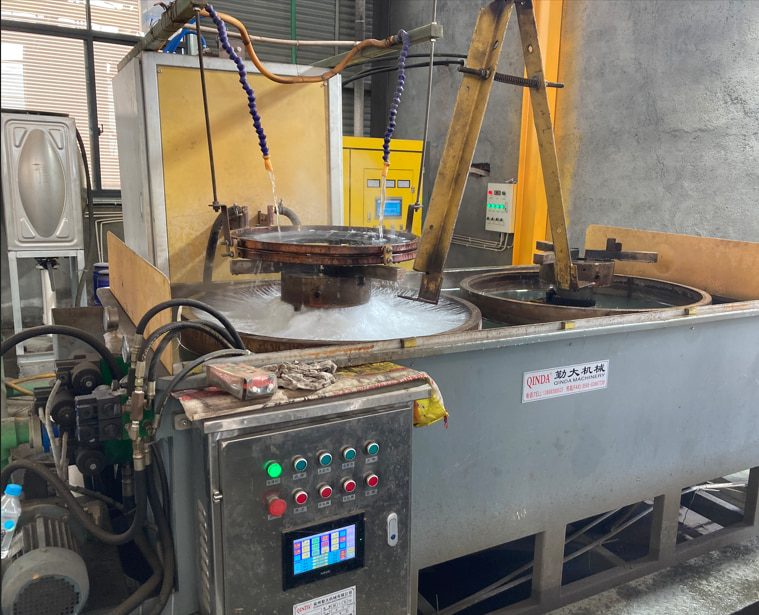
Medium and high-frequency treatments are technically known as Induction Hardening. This is a physical heat treatment where electromagnetic induction generates a current on the part's surface, causing instantaneous heating followed by rapid quenching.
The Difference: The higher the frequency, the more concentrated the current is on the surface, resulting in a shallower hardened layer.
High Frequency: Ideal for small parts, small gears, or pins where only a thin hardened shell is needed.
Medium Frequency: Offers a deeper hardened layer, making it ideal for large gears, track roller treads, and the rail surface of bulldozer track links.
In the production of high-quality bulldozer track links made from 35MnB, Q+T and Medium Frequency are not "either-or" choices; they are the "Golden Duo."
Q+T (The Backbone): Performed early in the manufacturing process, Q+T ensures that the entire bulldozer track links block will not deform or snap when subjected to dozens of tons of traction and heavy impact. It serves as the "skeleton" of the link.
Medium Frequency (The Armor): After Q+T, medium frequency induction hardening is applied to the rail surface—the area that constantly rubs against the rollers. This provides a hardened layer of 3-7mm, ensuring the rail surface does not collapse or wear down prematurely, even in abrasive sandy conditions.
In the manufacturing of undercarriage parts for your bulldozers and excavators, these processes are usually used in coordination. Many buyers focus solely on the weight of the parts, but they often overlook the critical heat treatment processes.
Understanding these manufacturing techniques will help you choose bulldozer track links and other components that are truly suited for your specific working conditions, ensuring maximum machine uptime and lower cost-per-hour.
Address : Building 17, Block 9, Section D, 27th Road, Chenghui International Hardware and Electrical City, Xiamei Town, Nan'an City, Quanzhou, Fujian Province
Wechat :

Please read on, stay posted, subscribe, and we welcome you to tell us what you think.


Copyright © 2026 Quanzhou Futeng Machinery Engineering Co.,Ltd All Rights Reserved.
Sitemap
|
Blog
|
Xml
|
Privacy Policy
 Network Supported
Hi! Click one of our members below to chat on
 English
 English
 Русский
 Español