
The primary function of bulldozer track chains is to support and drive the track system, ensuring stable operation in complex terrains. Based on lubrication methods, track chains are categorized into lubricated (oil) chains and dry chains. Below, we analyze them step by step.
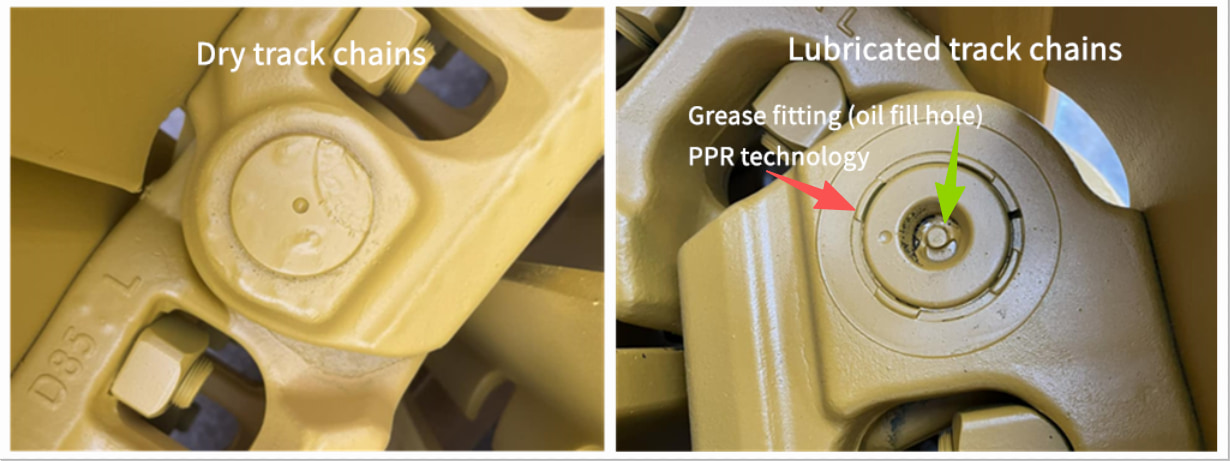
First, you can easily distinguish between lubricated track chains (oil chains) and dry track chains by appearance: lubricated chains have a grease fitting (oil fill hole) on the track pin, while dry chains do not.
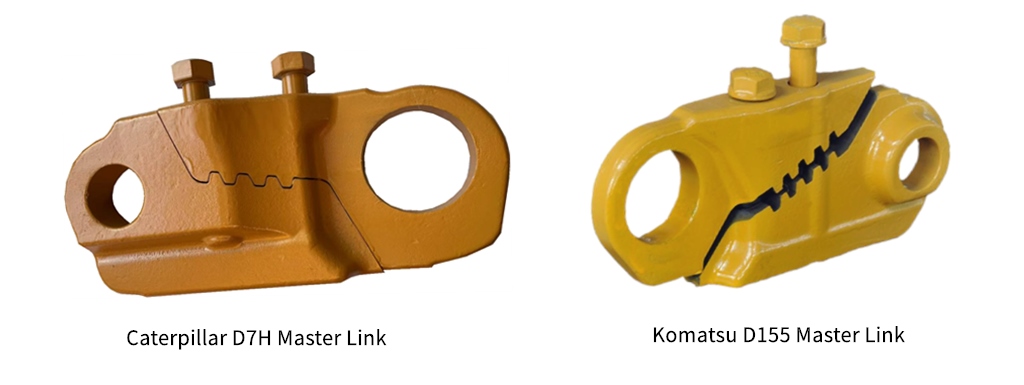
Second, lubricated chains are typically equipped with master links, and although dry chains may also include master links for easier installation in some cases, this is not the primary difference between the two.
Third, some high-end lubricated track chains incorporate PPR technology (Positive Pin Retention).
In this design, a metal retaining ring is mechanically pressed into a specific groove between the track pin and the link, positively locking the pin in place and strictly controlling end-play (axial clearance) to the factory-specified value.
This greatly enhances resistance to end-play growth, keeps the sealing surfaces in constant contact, maintains a stable oil film, and significantly extends the chain’s service life.
For many large bulldozers, PPR-equipped lubricated track chains are strongly recommended or even standard, including:
· Caterpillar: D8T, D9T, D10T, D11T
· Komatsu: D275, D355, D375, D475
Here’s a clear comparison between lubricated track chains (oil chains / SALT) and dry track chains, focusing on structure, performance, maintenance, cost, and best applications.
1. Structure & Manufacturing
Lubricated Track Chains: Sealed design with high-viscosity oil injected between pin and bushing, protected by O-rings or floating seals. Requires precise heat treatment (HRC 50-60), automated oil filling, and high-pressure sealing. More complex and ~5–10% heavier.
Dry Track Chains: No oil or seals — pin and bushing in direct contact, hardened via carburizing/nitriding. Simpler forging/casting + surface treatment. Lower cost, lighter, shorter production time.
2. Performance & Lifespan
Friction & Wear
Lubricated: Low friction (0.05–0.1), 30–50% slower wear, excellent in mud/water/sand.
Dry: Higher friction (0.2–0.4), faster elongation in abrasive/dry conditions.
Noise & Vibration
Lubricated: Smoother, quieter (70–80 dB).
Dry: Noisier and more vibration (80–90 dB).
Typical Lifespan
Lubricated: 5,000–8,000 hours.
Dry: 3,000–5,000 hours (depending on conditions).
3. Maintenance & Cost
Lubricated: Check seals every ~500 hours; replenish oil or replace seals if leaking. Higher upfront cost (1.5–2× dry), but lower long-term cost due to longer life.
Dry: Simple — clean dirt, inspect wear, no oil needed. Lower initial cost (20–30% cheaper to produce), but more frequent full replacements. Prone to rust in wet environments.
4. Best Use Cases
Choose Lubricated Track Chains when:
Harsh/wet/muddy conditions
Mining, forestry, wetland work
Heavy-duty machines (e.g., Cat D11, Komatsu D475)
→ Prioritize longevity and reduced downtime.
Choose Dry Track Chains when:
Dry, sandy, or flat terrain
Budget-limited or short-term projects
Smaller machines (e.g., John Deere 450)
→ Prioritize low cost and easy on-site repairs.
Conclusion
Lubricated bulldozer track chains excel in durability and harsh environments thanks to sealed oil lubrication, while dry track chains win on cost, simplicity, and light-duty applications. Select based on your soil type, workload, budget, and machine model — the right choice significantly improves efficiency and cuts overall operating costs.
If you need model-specific recommendations, feel free to provide more details.

Address : Building 17, Block 9, Section D, 27th Road, Chenghui International Hardware and Electrical City, Xiamei Town, Nan'an City, Quanzhou, Fujian Province
Wechat :

Please read on, stay posted, subscribe, and we welcome you to tell us what you think.


Copyright © 2026 Quanzhou Futeng Machinery Engineering Co.,Ltd All Rights Reserved.
Sitemap
|
Blog
|
Xml
|
Privacy Policy
 Network Supported
Hi! Click one of our members below to chat on
 English
 English
 Русский
 Español